US-China AI Race: The Growing Battle Between Speed and Safety
USA-China AI race accelerates as both seek dominance while grappling with safety risks.
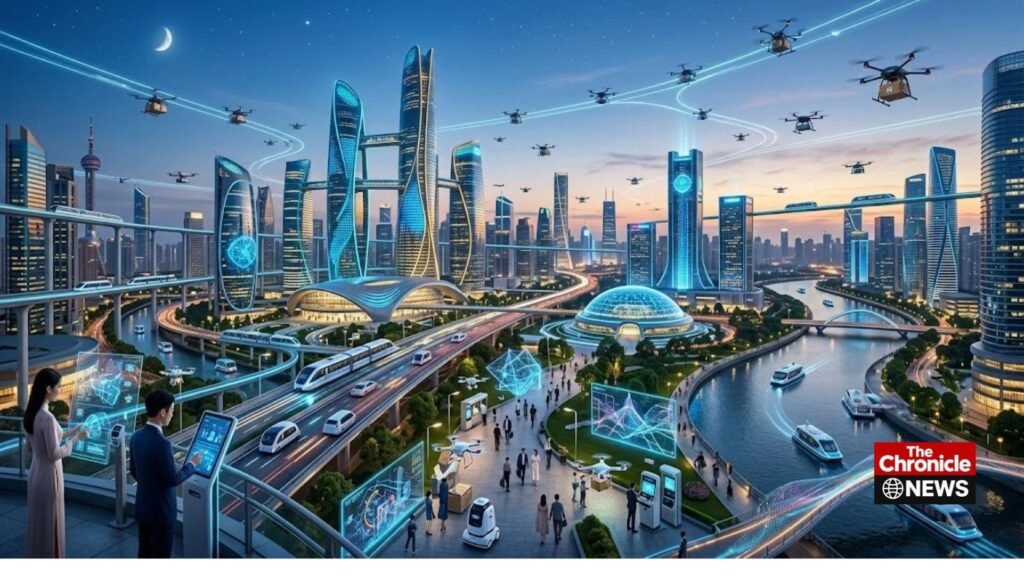
चीन का AI में बढ़ता दबदबा दुनिया के लिए खतरा है।
The debate over whether advanced artificial intelligence could one day threaten humanity is happening alongside a much more immediate reality: the United States and China are racing to dominate AI, and neither side appears willing to slow down.
For Beijing, AI is no longer just another emerging technology. It has become a matter of economic strength, national security and political power.
China Wants to Lead the AI Revolution
In 2025, Beijing updated its national AI strategy and stepped up efforts to direct government resources, state-backed companies and research institutions toward AI infrastructure, talent and large-scale model development.
The ambition is straightforward: China wants to become a global leader in AI, robotics and advanced manufacturing by the end of the decade.
But China’s interest in AI goes beyond economic growth. Chinese officials also see the technology as something that could either strengthen or threaten the Communist Party’s control. That has created a unique combination of massive investment and strict ideological restrictions over what AI systems are allowed to produce.
US Chip Controls Forced China to Innovate
Washington’s restrictions on advanced semiconductor exports created a major challenge for Chinese AI companies. Access to the most powerful chips became more difficult, limiting the amount of computing power available to some Chinese labs.
Instead of simply trying to match America’s computing capacity, Chinese researchers increasingly focused on making their systems more efficient.
The rapid rise of DeepSeek in 2025 became an important example of this approach. Its progress suggested that better software, smarter architectures and more efficient use of computing resources could help close the gap with much larger AI systems.
Recent evaluations have reinforced that point. Some public benchmarks now show leading American and Chinese models performing remarkably close to one another in several areas.
America Still Has Important Advantages
China may be closing the gap, but the United States still holds significant advantages.
American companies continue to benefit from enormous private investment, access to advanced computing infrastructure and a highly competitive frontier-model ecosystem. The country also has a substantial lead in building large-scale data centers.
However, the old assumption that America is comfortably ahead in every aspect of AI is becoming harder to defend.
The competition is becoming much closer—and that makes the question of AI safety even more complicated.
The Safety Debate Is Growing in America
At the same time that companies are racing to build more powerful AI, researchers and technology executives in the United States are warning about what could happen if these systems become too capable.
Some experts fear that future AI systems could eventually become difficult to control. Others point out that there is still no clear threshold at which AI suddenly becomes an existential threat.
Nobody can say with certainty how much computing power—or what combination of new techniques—would be enough to create such a danger.
That uncertainty makes the debate particularly difficult.
Slowing Down Could Help China
There is another problem with calls for an AI slowdown: geopolitics.
The United States cannot simply assume that China will pause at the same time.
President Donald Trump has rejected the idea of voluntary restrictions that could leave America behind. From Washington’s perspective, slowing down while China continues developing its AI capabilities could create a serious national-security disadvantage.
Anthropic CEO Dario Amodei has offered a more limited approach. His argument is that the United States should maintain a modest lead, use that position as leverage and then push for binding international rules on the most dangerous AI capabilities.
China, however, has dismissed such proposals as another form of strategic pressure from Washington.
China Has Its Own AI Fears
Despite the rivalry, there is one important point of common ground.
China also has reasons to fear uncontrolled AI.
Beijing does not want powerful AI systems operating beyond government supervision. It is also concerned about AI being used against China through cyberattacks, disinformation and other information operations.
In other words, both countries have reasons to worry about AI becoming too powerful—although their political motivations are very different.
That shared concern could eventually provide the foundation for negotiations.
An AI Race That Looks Increasingly Like a Nuclear Standoff
The current situation increasingly resembles earlier nuclear confrontations.
Both Washington and Beijing have a national-security reason to make sure they do not fall behind. At the same time, both have an interest in preventing the development of systems that cannot be reliably controlled or predicted.
Treating these two objectives as mutually exclusive could create a dangerous cycle: each side keeps accelerating because it fears that slowing down will give the other side an advantage.
But treating them as two goals that must be pursued simultaneously offers a possible way forward.
What Could an AI Agreement Look Like?
A realistic agreement would probably not mean stopping AI development altogether.
Instead, the United States and China could continue competing in relatively safe and commercially useful areas while establishing international rules for the most dangerous capabilities.
Those rules could potentially cover extremely large-scale computing, certain types of autonomous AI systems and mechanisms for verifying that agreed limits are actually being followed.
Such an arrangement would be difficult to negotiate—and neither Washington nor Beijing currently appears eager to make that deal.
The Race Is Far From Over
For now, the AI competition continues.
Models are becoming more capable, computing clusters are getting larger and governments are increasingly treating AI as a strategic asset.
The biggest question is no longer simply who will build the most powerful AI.
It is whether the countries building these systems can compete aggressively while still keeping the technology under meaningful human control.
Because if the race continues without any safety rules, the biggest risk may not be that one country wins.
It may be that both sides move so quickly that neither knows how to stop.