SC Notice to Centre, NALSA Over UP Legal Aid Counsels’ Contracts
.Supreme Court Issues Notice to Centre, NALSA on UP Legal Aid Defence Counsels’ Challenge to Contract Non-Renewal
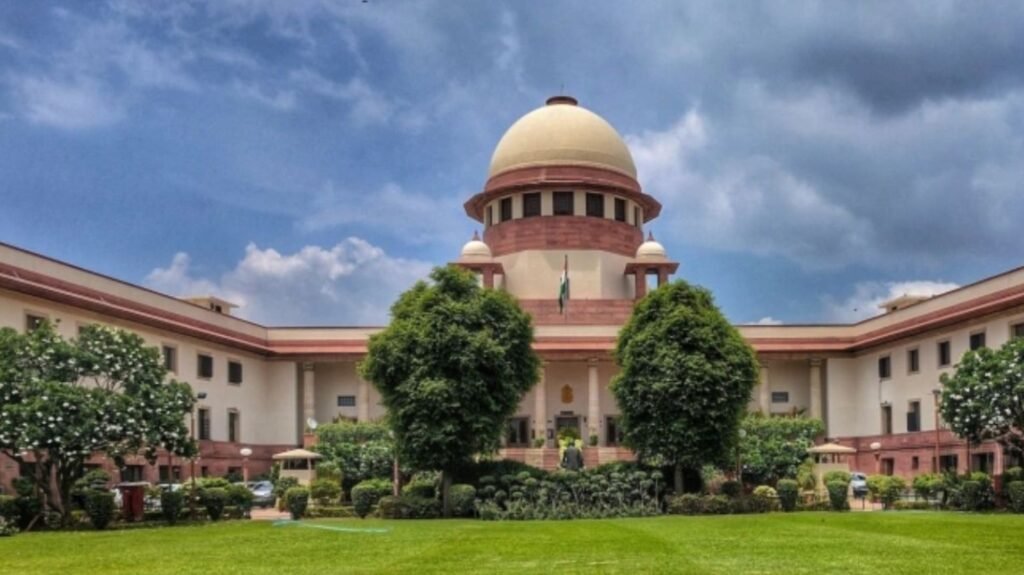
Supreme Court of India
The Supreme Court has issued notice to the concerned parties — including the Union of India and the National Legal Services Authority (NALSA) — on a writ petition filed by serving Legal Aid Defence Counsels (LADCs) from Uttar Pradesh.
The petition challenges NALSA’s 4 August 2026 communication directing that LADC contracts across the country will not be renewed after their present terms end. The case is Vichitra Kumar & Ors. v. Union of India & Ors. (Diary No. 53936 of 2026), filed on 1 September 2026 under Article 32 of the Constitution.
The petitioners are Assistant and Deputy Chief LADCs working in districts including Ghaziabad, Baghpat, Saharanpur, Ballia, Mau and Ghazipur. They do not claim a right to permanent jobs. Their case is that NALSA cannot shut down a national legal-aid system through an administrative letter while its own review committee is still at work.
What is the LADC Scheme?
In 2022, NALSA introduced the Legal Aid Defence Counsel (Modified) Scheme as a full-time public-defender model for criminal legal aid.
Unlike the older panel system, where private lawyers take legal-aid briefs alongside their own practice, LADCs are selected through a prescribed process, work full-time on legal-aid criminal matters, and continue only if their performance reviews are satisfactory.
Official figures cited in the petition and later commentary show how large the system became. A Ministry of Law and Justice press release dated 13 March 2026 recorded LADC offices in 680 districts as on 31 December 2025; 12,62,857 cases assigned; 8,71,581 disposed of; 2,76,476 undertrial prisoners given representation; and 59,630 undertrials released during FY 2025-26 up to December 2025.
Independent reporting has also noted that LADCs handled a much higher remand and bail workload per lawyer than the older panel model. Prime Minister Narendra Modi and the then Chief Justice of India publicly praised the scheme in November 2025 for helping dispose of about 8.5 lakh cases in a year.
Why Did NALSA Stop Renewals?
The controversy grew in Punjab, Haryana, Himachal Pradesh and Chandigarh. Sections of the Bar said a salaried, exclusive defence cadre was affecting work opportunities for young private lawyers. There were strikes and representations.
On 13 July 2026, the Bar Council of Punjab and Haryana resolved to seek a rollback of the existing framework.
NALSA had already set up a high-level committee on 6 March 2026 to revisit the scheme and policy. That committee includes sitting High Court judges and senior legal-services officials.
On 3 August 2026, NALSA met Bar representatives from those northern jurisdictions. The next day, it issued the communication challenged before the Supreme Court.
The letter stated:
- LADC contracts in Punjab, Haryana and Chandigarh would not be renewed from September 2026.
- In all other States and Union Territories, contracts would not be renewed once the current tenure ends.
- District Judges would then assign legal-aid work to members of the Bar, preferably young lawyers.
The same letter also sought “specific and constructive inputs” from the Bar on operational issues, even though it had already decided that the existing cadre would be phased out.
What Are the UP Lawyers Arguing?
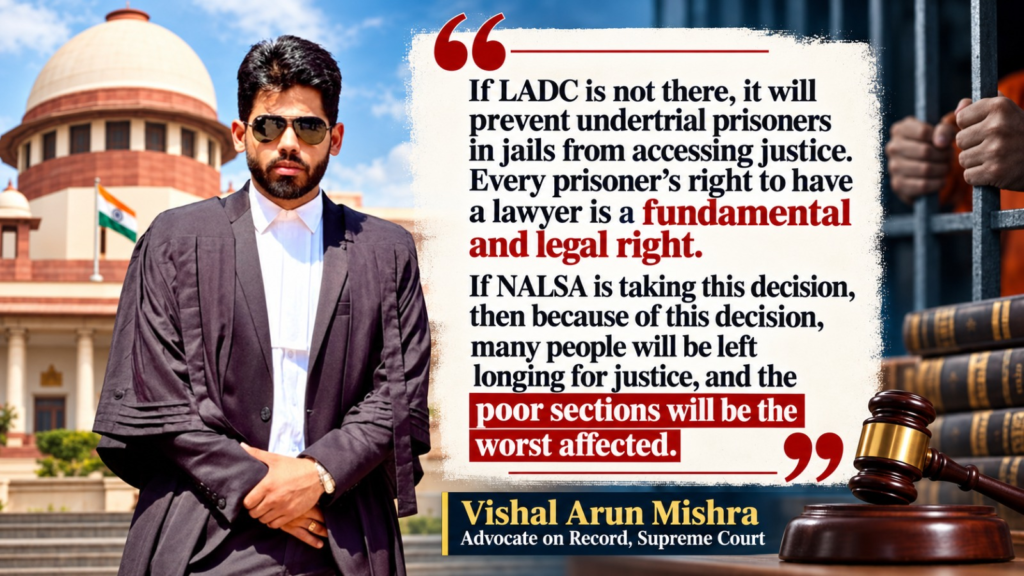
The petitioners say the decision is not merely a routine contractual matter. They argue that it amounts to a national policy change affecting a mechanism created to fulfil Articles 14, 21 and 39A of the Constitution, concerning equality, life and personal liberty, and free legal aid.
Their main arguments are:
1. Review Is Still Pending
NALSA itself constituted a committee in March 2026 to review the scheme. The petitioners argue that the 4 August communication effectively predetermined the outcome before that committee completed its work.
2. No Published Failure Report
The communication does not, according to the petitioners, establish that the LADC scheme had failed nationally or that it had failed in Uttar Pradesh.
3. Local Protest, Nationwide Effect
The petitioners argue that the agitation was concentrated in Punjab, Haryana and Chandigarh, but the decision to end renewals was extended across the country without a State-wise assessment.
4. Performance-Based Renewal
The 2022 Scheme provides for continuation based on satisfactory performance. The petitioners argue that blanket non-renewal ignores the experience and performance of serving LADCs.
5. Serving LADCs Were Not Heard
The petitioners submitted a representation on 15 July 2026. They contend that the challenged communication does not demonstrate that their concerns were considered, even though Bar bodies were invited to provide inputs.
6. No Clear Transition Plan
The petitioners argue that thousands of pending criminal cases and undertrial prisoners could lose continuity of legal representation if trained full-time LADCs are replaced by ad hoc assignments to private practitioners.
7. Earlier Court View
On 18 December 2025, the Madhya Pradesh High Court set aside an SOP that required existing LADCs to undergo fresh selection after two years. The court held that the move was contrary to the 2022 Scheme. That judgment was subsequently challenged before the Supreme Court.
The petitioners accept that NALSA has the authority to review or restructure the scheme. Their argument is that such a major change cannot be implemented through an administrative direction without adequate reasons, supporting data and consideration of the ongoing review process.
What Do the Petitioners Want From the Court?
The petitioners have asked the Supreme Court to:
- Quash the 4 August 2026 communication insofar as it prevents renewal of LADC contracts in the remaining States, including Uttar Pradesh.
- Direct that the existing system continue under the 2022 Scheme, with renewal decisions based on performance and experience.
- Restrain implementation of the decision against UP LADCs while the case remains pending.
Why Does the Supreme Court Notice Matter?
Issuing notice does not mean that the Supreme Court has accepted the petitioners’ arguments. It means the Union of India and NALSA have been called upon to respond to the petition.
A similar challenge by LADCs from Assam, Meghalaya and Nagaland had already drawn notice from a Supreme Court Bench of Justices M.M. Sundresh and P.B. Varale on 25 August 2026.
The UP petition places the same national communication under scrutiny from another State where, according to the petitioners, there was no comparable Bar agitation and no finding that the scheme had failed.
The broader issue before the Court is whether an established national mechanism for criminal legal aid can be phased out through an administrative communication while the official review is incomplete, and without a publicly available assessment of its impact on undertrial prisoners and pending criminal trials.